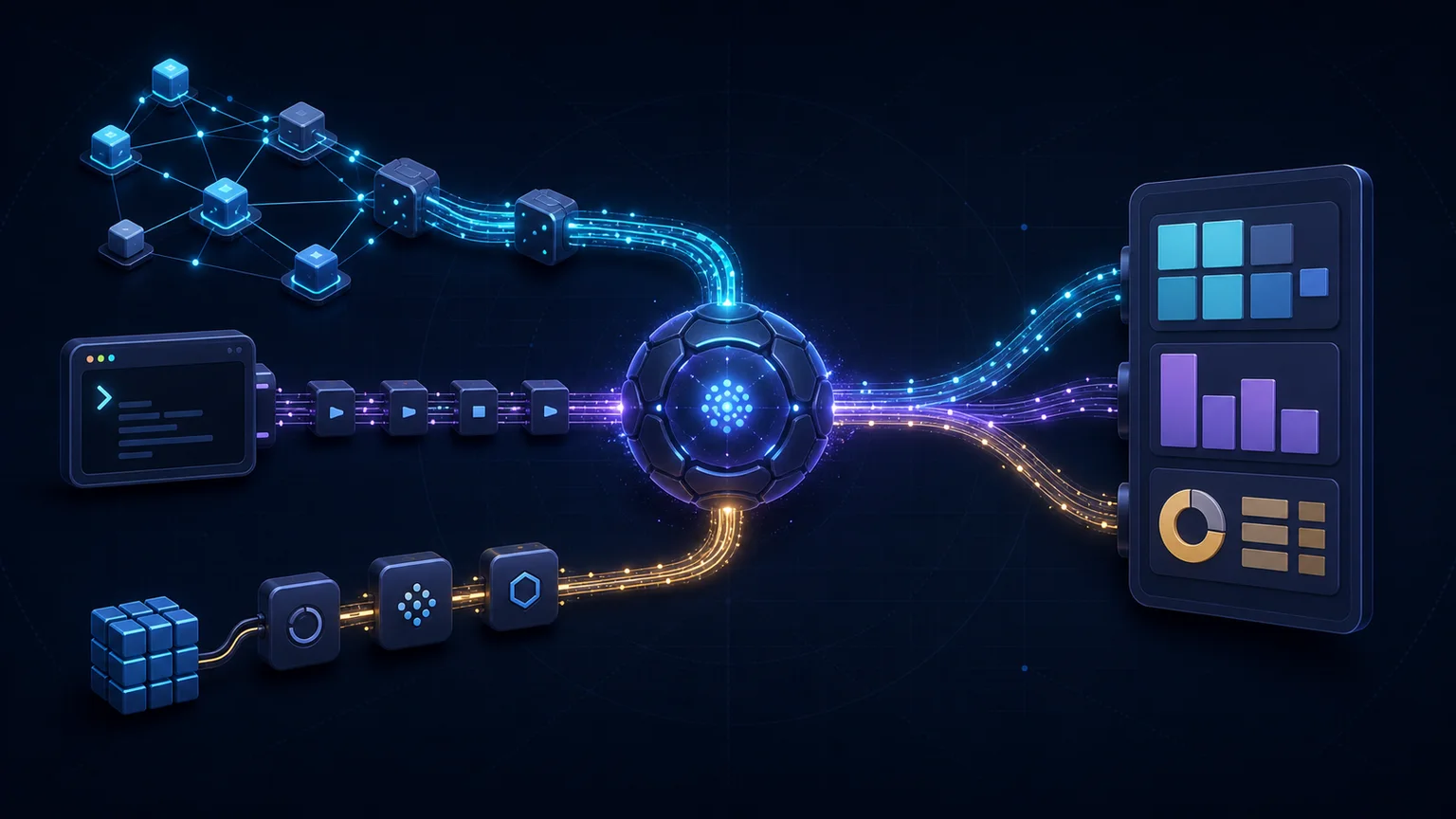
“MCP vs CLI” sounds like a contest, but it starts with a category mistake. The Model Context Protocol (MCP) defines communication between a host, clients, and servers. A command-line interface (CLI) defines how a process receives arguments and returns an exit code, stdout, and stderr. A direct API exposes functions or network endpoints to application code.
Any of them can eventually perform the same operation. An MCP tool may call a CLI. A CLI may call an operating-system API. A direct SDK may send HTTP. The important decision is not which acronym wins; it is where discovery, validation, authorization, execution, and result normalization should live.
If MCP is new to you, begin with our practical Model Context Protocol guide. It explains hosts, clients, servers, tools, resources, prompts, transports, authorization, and the security boundary before comparing integration choices.
What MCP, CLI, and API mean in practice
MCP: a protocol boundary for AI applications
MCP uses a client-host-server architecture. A host such as an AI application creates client connections to servers. Servers can expose tools for actions, resources for contextual data, and prompts for reusable interaction templates. The protocol uses JSON-RPC messages and standard transports including local stdio and Streamable HTTP.
This makes MCP useful when the host should discover capabilities through a shared protocol, connect to local or remote services, negotiate features, and apply a consistent permission experience. It also introduces a server lifecycle, protocol schemas, transport behavior, and security obligations that a simple process call may not need.
CLI: a process boundary already available to many agents
A CLI receives arguments, runs as a process, and reports through its exit status and output streams. Agents such as Codex, Claude Code, and Gemini CLI often already have a terminal tool, so a documented executable can be usable without a dedicated protocol adapter.
A good machine-facing CLI is more than text made for people. It should provide stable arguments, bounded output, meaningful exit codes, and structured data on demand. QZX follows that idea: human output is the default, while --json returns the complete structured result and every public command includes at least success and message.
Direct API or SDK: an application boundary
A library API keeps execution in process and can offer native types, exceptions, callbacks, streaming, and fine-grained control. A service API can expose a domain over HTTP with its own authentication and versioning. For an application you control, a maintained typed SDK is often the strongest integration because the compiler, language server, and tests understand its contract.
The tradeoff is coupling: code must use that programming language or service model, and an AI host cannot discover the integration unless the application exposes it as a tool.
MCP vs CLI vs API comparison
| Decision area | MCP | CLI | Direct API or SDK |
|---|---|---|---|
| Primary boundary | AI host to MCP server | Caller to operating-system process | Application code to library or service |
| Discovery | Protocol methods advertise tools, resources, prompts, and capabilities | Help, documentation, a catalog command, or package metadata | Types, documentation, schemas, generated clients, or service discovery |
| Transport | JSON-RPC over stdio or Streamable HTTP |
Arguments, environment, exit code, stdout, and stderr | Function calls, IPC, or HTTP depending on the API |
| Best fit | Reusable AI integrations across compatible hosts | Direct local tools, scripts, build systems, and terminal-capable agents | Product code needing native domain types and control |
| Typical overhead | Server configuration, schemas, lifecycle, protocol, and authorization | Process startup, argument validation, and output parsing | Dependency management, language coupling, or service authentication |
| Portability question | Does the host implement the required MCP features? | Does the executable run and keep its contract on this platform? | Does the SDK or endpoint support this runtime and version? |
| Security owner | Host, client, server, transport, and resource service share responsibility | Caller and executable enforce permissions, arguments, and process isolation | Application and service enforce authorization, input validation, and secret handling |
A practical decision sequence
- Start with the workload. Name the exact operation, data source, mutation, latency target, and failure behavior.
- Identify the host. Does it have an MCP client, a terminal tool, application code you control, or more than one?
- Prefer the maintained contract closest to the domain. A first-party typed SDK is often better for product code. A stable CLI may be better for local automation. MCP may be better for reusable host integration.
- Count operational boundaries. Every server, process, credential, transport, and adapter needs deployment, logging, updates, and incident handling.
- Model permissions before convenience. Decide which operations are read-only, mutating, privileged, networked, or externally shared.
- Measure the complete agent loop. Include tool definitions, discovery, process or network time, result size, retries, and model-tool rounds.
If a terminal-capable agent needs a local date, file search, project tree, or system fact, a CLI can be the shortest reliable path. If many compatible AI hosts need the same remote business integration, MCP can remove bespoke host adapters. If a service is already controlled by application code with a high-quality SDK, wrapping it twice may create more maintenance than value.
Where QZX fits
QZX — Quick Zap Exchange is currently a CLI, not an MCP server. Its purpose is to give people, automation, and AI agents a documented command vocabulary for supported operations across Windows, Linux, and macOS. A terminal-capable agent can invoke it directly:
qzx version --json
qzx listCommands --json
qzx help findFiles --json
qzx findFiles . "*.py" -r --format name --json
The first two calls prevent a common integration error: assuming that a command described in development documentation exists in the installed PyPI wheel. The help call exposes the local parameter contract. The final call requests structured output for the actual operation.
QZX is attractive when its documented command already matches the task and a consistent cross-platform shape reduces shell branching or ambiguous text parsing. It is the wrong layer when the operation is absent, a maintained native SDK offers a stronger contract, or the workflow needs capabilities that QZX does not model.
What the current QZX evidence demonstrates
The project's evidence registry contains implementation-bound stdout for 23 safe commands using QZX 0.2.2.0.15, CPython 3.13.13, on Windows 11 10.0.26200. The capture disables telemetry, uses controlled local fixtures where needed, requires one valid JSON document, verifies success, and checks the expected process exit code. The linked evidence pages show the capture date and excerpts from the recorded outputs.
That evidence demonstrates those exact QZX executions and their result shapes. It does not prove that CLI is faster than MCP, that QZX always uses fewer tokens, or that every command behaves identically on every platform. A valid MCP-vs-CLI benchmark would need the same workload, permissions, data, result semantics, host, and repeated measurements through both boundaries.
You can inspect the recorded examples and command pages such as getCurrentDateTime and listCommands. Each page states whether its output is recorded or representative.
When combining MCP and CLI is the right design
An MCP server can expose a carefully selected subset of a CLI. The server validates a typed tool request, maps it to fixed arguments, runs the process, interprets the exit code and JSON, and returns an MCP tool result. This can make one mature CLI available to multiple compatible hosts.
The adapter should not be a transparent “run anything” escape hatch. A professional wrapper needs an allowlist, bounded arguments and output, timeouts, working-directory rules, environment filtering, approval policies, and explicit handling of partial mutations. It must also preserve QZX safety facts such as preview support, required authorization, and backups for dangerous file operations.
Until such an adapter exists and is independently tested, describe QZX accurately: a CLI that agents with terminal access can use.
Security: none of the three is a sandbox
MCP formalizes communication; it does not make every server trustworthy. The official MCP security guidance covers risks such as compromised local servers, credential exposure, SSRF, and unsafe authorization. A local server can execute with the client user's privileges unless isolation restricts it.
A CLI has the same fundamental boundary: it runs with the current process permissions unless the operating system or host places it in a sandbox. A direct API can also mutate data or expose secrets if its caller is over-authorized. In every architecture:
- grant the smallest useful filesystem, network, and service scope;
- separate read-only discovery from mutation;
- validate every argument at the boundary that executes it;
- keep credentials out of prompts, command lines, stdout, and logs;
- require human approval for consequential actions;
- record enough structured evidence to diagnose what happened.
Frequently asked questions
Is MCP better than a CLI for AI agents?
Not universally. MCP is strong for protocol-level discovery and reusable host integrations. A CLI can be smaller and more direct for local work when the agent already has a terminal tool.
Can an MCP server call a command-line tool?
Yes. It can expose selected operations, validate arguments, execute the CLI, and translate the result. The wrapper adds responsibilities for permissions, timeouts, output limits, and failure semantics.
Is a CLI an API?
It is a process interface rather than an in-process library API. Its contract consists of arguments, environment, exit code, stdout, and stderr, and it can still be stable and machine-readable.
When should an AI agent use QZX?
When a documented installed command matches a local operation and QZX's cross-platform vocabulary or structured JSON helps. If the command is absent or a maintained native API is stronger, use the better-fitting interface.
Is QZX an MCP server?
No. QZX is currently a CLI. An independently designed adapter could expose selected commands through MCP, but that is a separate integration with its own security and testing work.
Which interface uses fewer AI tokens?
There is no universal answer. Measure tool definitions, discovery, result size, retries, and complete model-tool rounds for the same workload.
Does any interface make agent execution safe by itself?
No. The host still needs authorization, isolation, validation, secret handling, observability, and human approval where the consequences require it.